
The Inflation Report Is Out: Can Monthly Income From Real Estate Debt Keep Up?
The September 2026 Consumer Price Index (CPI-U) rose 3.7% year over year, per the U.S. Bureau of Labor Statistics. For income-focused accredited investors, a low savings or CD rate can still lose purchasing power after inflation. Private real estate debt income may help close that gap when collateral, terms, and liquidity fit—but it is illiquid, uninsured, and not guaranteed.
The latest inflation print still shapes monthly income decisions.
On October 14, 2026, BLS reported that CPI-U rose 0.6% in September (seasonally adjusted) and 3.7% over the prior 12 months (not seasonally adjusted). Core CPI (all items less food and energy) was up 2.6% year over year; energy rose 20.4%; shelter rose 3.2%. The September index level was 336.940 (1982–84=100). Source: BLS CPI news release (series CUUR0000SA0).
For accredited investors, the useful question is: Can monthly income keep up with what dollars buy?
Refresh this piece when each CPI report posts. October 2026 CPI is due Tuesday, November 10, 2026, 8:30 a.m. ET (BLS schedule).
Table of Contents
- What does “real return†mean for monthly income?
- How has CPI-U moved over the past few years?
- How do common income options compare when inflation is 3.7%?
- How does real estate debt income work?
- What are the key risks of private real estate debt income?
- What is Summit Capital Group’s Monthly Income Program?
- FAQs
- Talk through current terms with Summit
- Ready to Put Your Capital to Work?
- Conclusion
What does “real return†mean for monthly income?
Real return is income (or total return) after inflation. A simple illustration:
Approximate real yield ≈ nominal yield − CPI year-over-year inflation
It ignores taxes, fees, and price changes—but it is a clear starting lens.
EXAMPLE: Nominal vs. approximate real yield after 3.7% CPI
| Income source (published figure) | Nominal | Approx. real (nominal − 3.7%) |
|---|---|---|
| FDIC national average savings | 0.38% | −3.32% |
| FDIC national average 12-month CD | 1.76% | −1.94% |
| 10-year U.S. Treasury yield | 4.91% | +1.21% |
| S&P 500 dividend yield (estimate) | ~1.07% | −2.63% |
| Summit Monthly Income Program stated annual yield* | 7.00% | +3.30% |
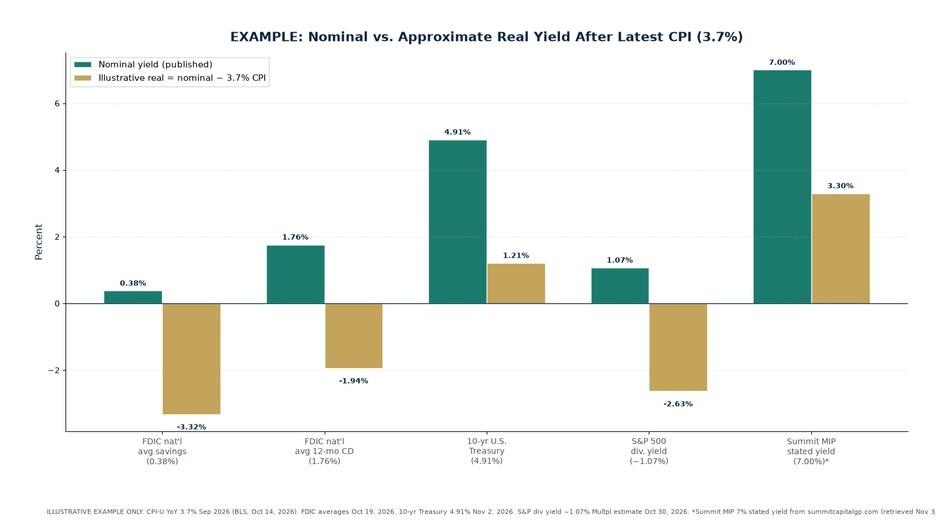
On $100,000, a 7% stated annual yield illustrates about $7,000 nominal over a year (~$583/month if paid evenly), or roughly ~3.3% real after 3.7% CPI in this simplified example. The same lens on the FDIC average savings rate leaves purchasing power lower. Example math—not a promise.
How has CPI-U moved over the past few years?
Headline CPI-U ran above 8% YoY through much of 2022, cooled in 2023–2024, then firmed again at points in 2025–2026. September 2026’s 3.7% YoY was higher than the 3.4% figure for the 12 months ending August 2026 (BLS).
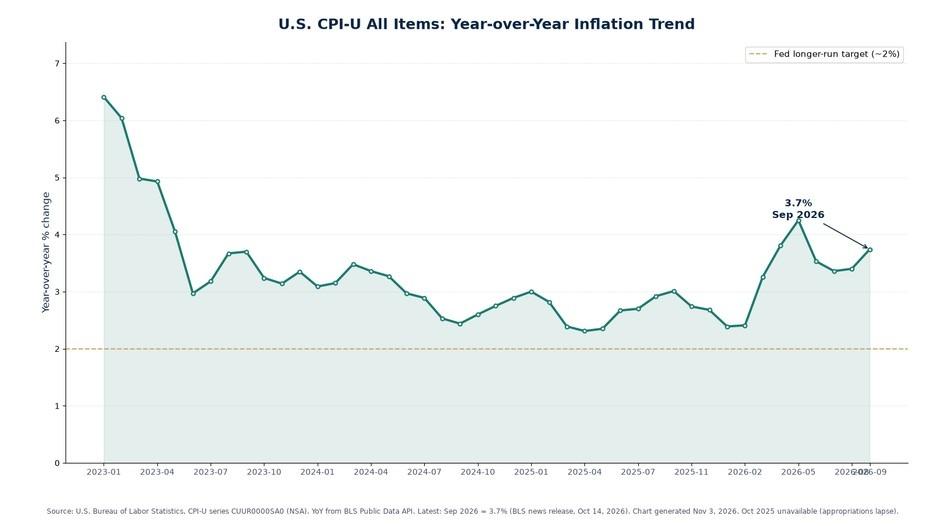
CPI-U (definition): The Consumer Price Index for All Urban Consumers tracks average price change for a market basket of goods and services purchased by urban consumers—the most widely cited U.S. consumer inflation gauge (BLS CPI).
How do common income options compare when inflation is 3.7%?
Savings and money market deposit accounts
Pros: Liquidity; FDIC insurance within limits. Risks: FDIC national average savings was 0.38% as of Oct 19, 2026—often negative in real terms near 4% CPI. Some banks beat the average; insurance alone does not grow purchasing power.
Certificates of deposit (CDs)
Pros: Known term rate if held to maturity; FDIC-insured within limits. Risks: FDIC national average 12-month CD was 1.76% as of Oct 19, 2026—below 3.7% CPI here. Early-withdrawal penalties cut flexibility. “Best†advertised APYs can exceed the average but are bank-specific.
U.S. Treasuries (10-year example)
Pros: Sovereign credit; deep market. The 10-year yield was 4.91% on Nov 2, 2026. Risks: Price declines if sold when yields rise; fixed coupons can lag sticky inflation.
Dividend stocks (S&P 500 lens)
Pros: Potential growth and public liquidity. Risks: Trailing dividend yield near 1.07% (Multpl estimate, Oct 30, 2026) is only the income slice. Prices fall; dividends can be cut. Total return may beat inflation long-term, but monthly income is not bond-like.
Private real estate debt income
Pros: Contractual borrower interest; property collateral with an LTV cushion; shorter bridge/construction books can recycle capital; stated yields often above insured deposits. Risks: Illiquidity; default; collateral decline; concentration; manager risk; accredited-only; not FDIC-insured; not guaranteed.
How does real estate debt income work?
Private real estate debt is capital lent against real property—often bridge or construction loans—rather than buying the equity.
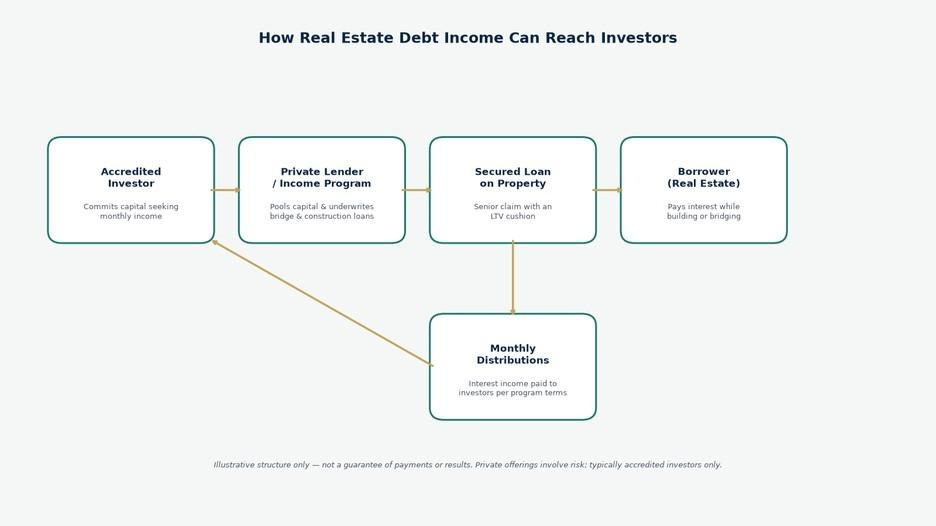
- Investors commit capital to a lender or income program.
- The lender underwrites loans secured by real estate.
- Borrowers pay interest under loan documents.
- Investors may receive monthly distributions per offering terms.
LTV cushion (definition): Loan-to-value compares loan size with underwritten property value. Lower LTV leaves more borrower equity beneath the loan, which can aid recovery—yet values can still fall and losses can still occur.
Summit Capital Group is a Houston private real estate lender offering bridge and construction loans to borrowers and income programs to eligible investors. See the Summit home page and Monthly Income Program.
What are the key risks of private real estate debt income?
- Illiquidity — Access follows note, callback, or fund terms.
- Default — Missed payments and costly workouts.
- Collateral / market risk — Values, costs, and exit financing can move against the loan.
- No FDIC insurance / no guarantee — Summit states opportunities are not FDIC-insured and returns are not guaranteed.
- Accredited-investor limits — Generally SEC accredited (plus program criteria).
- Manager and concentration risk — Underwriting quality drives outcomes.
Educational only—not personalized advice. Read offering documents; consult advisers.
What is Summit Capital Group’s Monthly Income Program?
Per the official Monthly Income Program page (retrieved Nov 3, 2026):
- Stated fixed annual return: 7%, paid monthly.
- Minimum investment: $50,000.
- Silver Tier: 7.00% annual yield; monthly payments; open term; 90-day callback framing for liquidity-minded investors.
- Gold Tier: 7.00% plus first month on day 1 (13 payments in 12 months); site lists 7.58% effective yield; 12-month term.
- Platinum Tier: Invitation only; $500,000+ minimum; private terms.
These are stated website terms, not assurances of payment or principal protection. Where Platinum or corporate options need bespoke discussion, contact us for current terms. Related reading: Preferred Funding.
Contact: Shan Momin · Summit Capital Group · 2100 West Loop South, Suite 1450, Houston, TX 77027 · (281) 766-8930 · [email protected]
FAQs
Can monthly income from real estate debt keep up with inflation?
It can help when the contractual yield exceeds CPI after taxes, fees, and credit risk—and when distributions are actually paid. With September 2026 CPI-U at 3.7% YoY, a 7% stated private yield illustrates a positive approximate real spread; FDIC national-average savings and CD rates in the October 2026 table do not. Stated yields are not guarantees.
Is private real estate debt an inflation hedge?
Not a perfect hedge. Resetting loan rates and hard-asset collateral can support income strategies in inflationary periods, but higher costs can also stress borrowers. Treat debt as income with collateral, not CPI insurance.
How is private real estate debt different from owning rental property?
Debt investors are generally creditors with rights set by loan documents. Equity owners take residual operating and sale outcomes. Debt emphasizes contractual interest; equity emphasizes rents, expenses, and appreciation.
Who can invest in Summit’s Monthly Income Program?
Typically accredited / qualified investors who meet applicable requirements. Confirm eligibility before investing (summitcapitalgp.com).
Are returns guaranteed or FDIC-insured?
No. Summit states returns are not guaranteed and investments are not FDIC-insured. The principal is at risk.
Talk through current terms with Summit
U.S. accredited investors weighing monthly real estate debt income alongside Treasuries, CDs, and equities—especially after each CPI release—can request current terms and offering materials:
Shan Momin · Summit Capital Group · (281) 766-8930 · [email protected] · 2100 West Loop South, Suite 1450, Houston, TX 77027
Monthly Income Program · Preferred Funding · How real estate generates monthly income
Ready to Put Your Capital to Work?
If you're comparing fixed-return options and want a structure built around clarity, real estate-backed security, and direct access to the people managing your capital, now is the time to explore your options.
Speak with Our Investment Team to review which tier fits your goals, or Join the Summit Capital GP Monthly Income Program to start building steady, real estate-backed monthly income.
Conclusion
With September 2026 CPI-U at 3.7% year over year, income choices should be judged by approximate real return—nominal yield minus inflation—not the headline rate alone. In that lens, FDIC national-average savings (0.38%) and 12-month CDs (1.76%) still lag purchasing power, while a 4.91% 10-year Treasury yield clears a modest real spread. Private real estate debt can offer higher stated contractual income secured by property and an LTV cushion, but it is illiquid, accredited-only, not FDIC-insured, and subject to default and collateral risk. Summit Capital Group’s Monthly Income Program lists a 7% stated annual yield (paid monthly; $50,000 minimum) on its site as of November 3, 2026—returns are not guaranteed. Revisit the comparison when each CPI report posts (next: November 10, 2026).
Disclaimer
This article is educational only and is not an offer or solicitation to buy any security. Offers are made solely via confidential offering documents. Private real estate debt involves substantial risk, including loss of principal, illiquidity, and no FDIC insurance. Stated yields are not guarantees. Past performance does not indicate future results. Third-party figures (BLS, FDIC, Treasury, Multpl) are cited as of the dates noted and change over time. Summit Capital Group and Shan Momin do not provide tax, legal, or personalized investment advice. Intended for U.S. accredited investors.
Recent Blogs







Contact Us
Disclamer
The investments and services offered by us may not be suitable for all investors. Summit Capital is not a bank. Investments are NOT FDIC insured and have no bank guarantee. Risk of loss exists. Investment in real estate involves a high degree of risk and may result in the loss of principal capital. Unlike a CD, a Monthly Income Program (Formerly Preferred Fund) investment is not guaranteed by the government. Past performance is not indicative of future results. "Summit Capital Group is not a registered broker-dealer or investment advisor. Content is for informational purposes only, and does not constitute financial, legal, or tax advice. Consult a financial professional before making investment decisions.